
Conceptual Process – Reflections in an AI Bubble
This writing documents the conceptual development and making of my “Reflections in an AI Bubble” resin artwork. I still don’t know whether this first iteration will be successful. This is part personal essay, part process log of the creative process.
Inspiration
Seven or so years ago I attended a conference where various luminaries of the financial services industry – the industry I had found myself in – spent a lot of time telling us that we would all be out of a job within three years ‘due to AI.’ I think that they were trying to motivate and inspire, in the only way they generally know how: through fear and bombastic statements. It turned me against the whole idea rather than piquing my curiosity.
A few years went by and we heard hardly anything about AI at all. The buzz words were blockchain and the Internet of Things. Then, seemingly out of nowhere, at least for me, AI was back and this time it meant business.
I was slow on the uptake, partly because of that initial hostility and cynicism, but gradually as the people around me started using it (mostly for fun – “give me a poem about this British Touring Car driver becoming a bounty hunter”, for instance), I started to give it a go. It was much easier this time because it was already on my phone and computer.
Since then, I’ve become quite the convert. I’m now more comfortable with the fact that it will change things in a major way, and already has, but that like any tool, the impacts and effectiveness will be informed by the intentions behind its use.
I tend to use AI as a mirror, something to tell my thoughts and ideas to, and see what comes back. If I don’t agree, I disregard it, but the conversation often sparks more ideas. The conversation often becomes a reflection. It was from this reflective element that the genesis of this piece came from and because I interact with AI mostly through my phone, the idea shifted from a mirror enclosed in a bubble, to a phone screen.
I’m old enough to remember the dot-com bubble clearly, a lot of the talk around AI feels familiar. AI in your fridge, your washing machine, your glasses. The desperate calls from CEOs to “use AI for everything”, even when its unnecessary. It’s so close to the late 90s habit of slapping the word ‘internet’ on anything, relevant or not. The circular finance, the hype, fears of a bust. It wasn’t hard to see my vision in a bubble.
Like the internet, AI is transformative, like the internet, it will produce fear, pain and outright slop. But it will also let us move forward and learn in ways that we have never seen before. Both are mirrors and insights into human nature.
Process
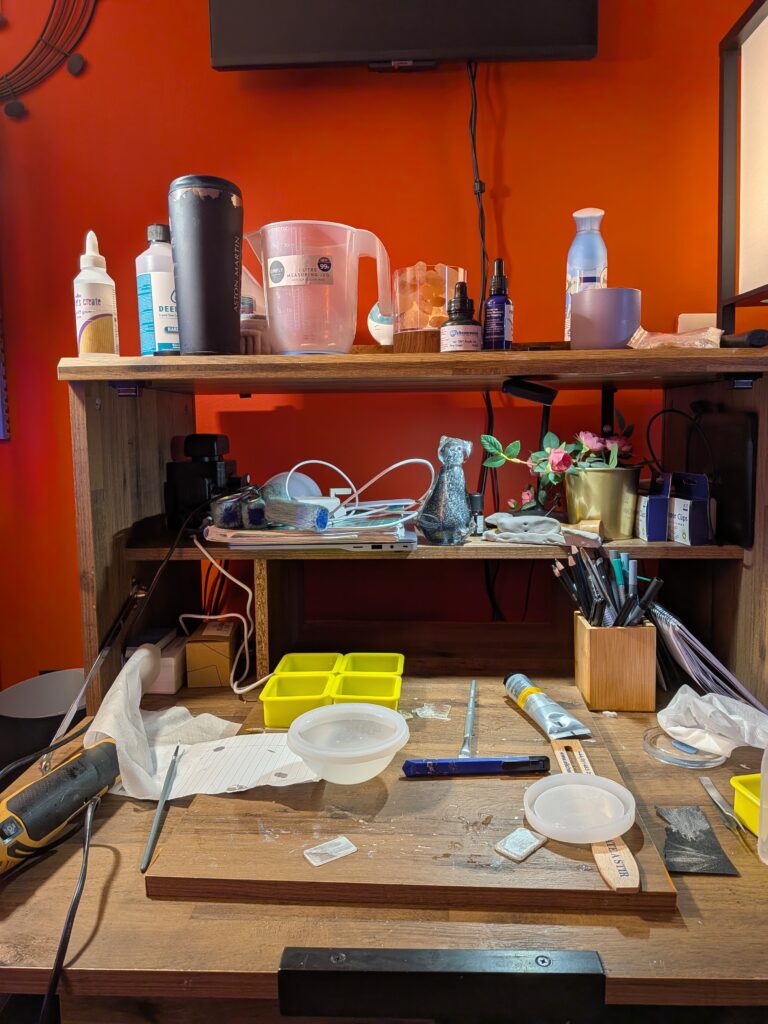
Before Christmas, I’d picked up a spherical silicon mould at one of Manchester’s art shops. I didn’t know what I’d use it for at the time, it was an impulse buy, but now I was thanking my past impulsive self.
My original thoughts were of using an actual phone screen, but it quickly became clear that making a bubble large enough to house one would be expensive, impractical and most importantly wouldn’t fit the mould. So I settled on making an artistic representation of a phone screen instead.
Making the Phone Screen
I’d already done quite a bit of practice with 24-hour cure epoxy while making Christmas presents and experimenting with bangles and coasters. It occurred to me that this resin could be the phone screen and that I could lodge it inside the deep pour resin I’d bought and not yet used. I’d originally bought the deep pour to convert one of my husband’s old guitars, which he’d deemed broken beyond repair, into a table…. He is still waiting!
So I poured the bottom half of the mould with the deep pour.
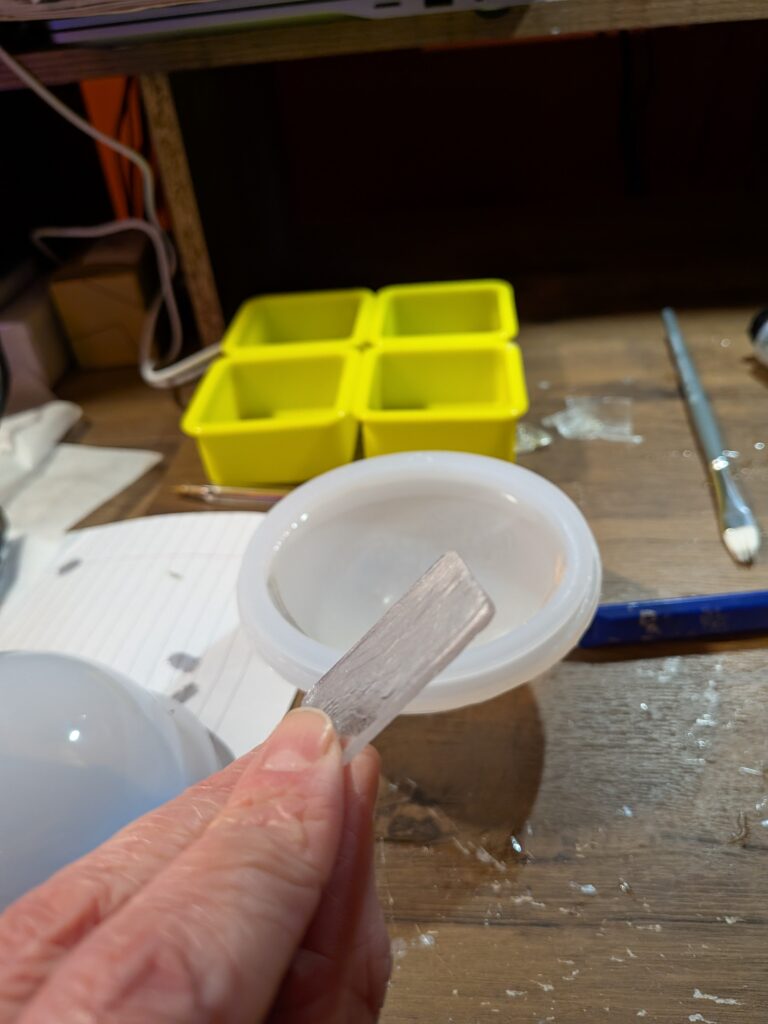
Then I made the ‘screen’. I poured a thin bit of clear 24-hour resin and left it for a couple of hours. After a few hours it was pliable and I discovered also cuttable with a Stanley knife. The first attempt at cutting a screen was a mess, the sides were too high up and ugly. Luckily the same pour had another usable section. Both pieces ended up with a shattered look – which I didn’t mind at all. It actually suited the concept, although it was unintended.
Once I was happy with the shape, I let it cure a little more and brushed a thin film of silver acrylic paint onto it. I only covered around half, to keep the idea of transparency while also invoking reflection.
Then came the waiting. Halfway through the next day, the resin still didn’t seem solid enough to hold the screen, and I had to leave for the weekend. Research told me I could let it cure completely and then sand the surface before pouring the next layer, so that was one contingency. One thing couldn’t wait, placing the screen inside the dome.
Suspending the Screen in the Deep Pour
Since the resin was still too viscous to hold the screen without it sinking, I rigged up a holder to suspend it while the deep pour cured around it. This “high-tech” solution involved taping together cotton buds with the ends cut off, with the screen taped to the middle. The unintended consequences were the structure dipping slightly across and some of the tape ending up in the resin. I had to adjust both the mould and the taped rig, which caused some swirl and some bubbles. It remains to be seen whether this ruins to the entire idea!
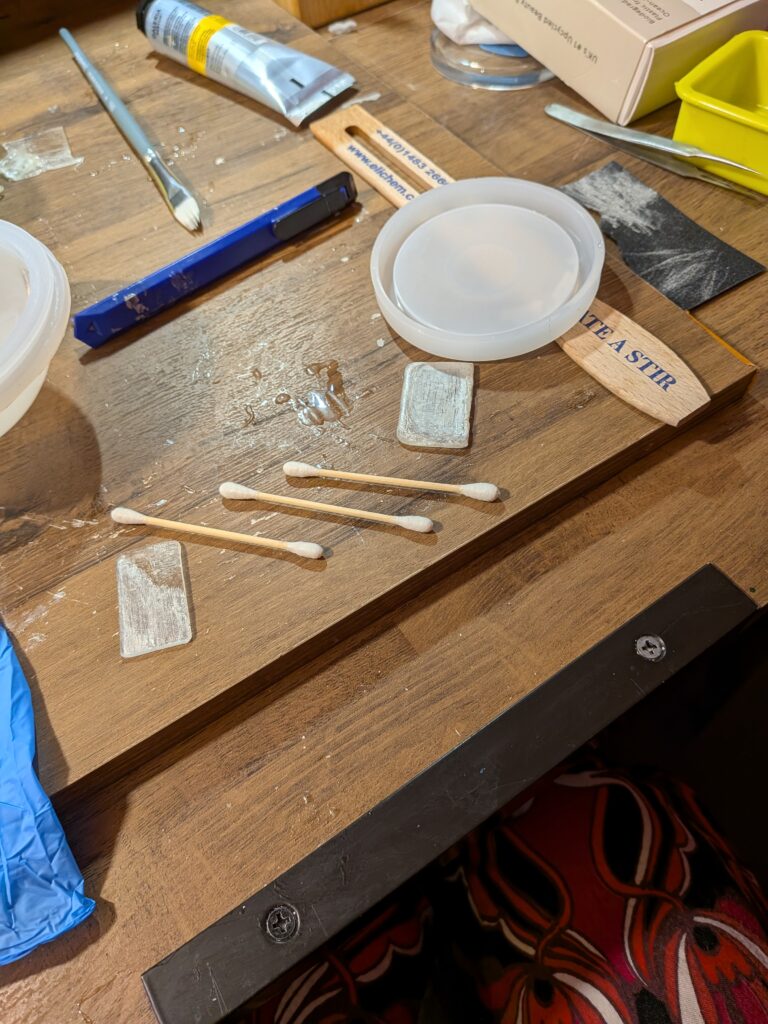
I went away for the weekend and on return, the half dome looked surprisingly good, though still a little tacky. That could mean I hadn’t mixed it right, even though I had felt sure I had. Still, I decided to pour the top half in any event.
Unexpected Consequences
This was more difficult than I expected. There’s a small hole in the top of the mould, which means no heat gunning to remove bubbles and no way to see what’s happening inside. It’s basically pour and hope. To make things more surreal when mixing the first batch of the second pour I discovered bits of dead insect at the bottom of the jug. After fishing them out I could only hope the two halves wouldn’t end up different colours.
Then the next day after I had left my sphere to cure in a ‘safe place’ I pushed something back on my desk only to have the whole thing fall behind my work space, requiring me to fish it out and thank the fact that it had cured enough to not go all over. One day a studio will prevent mishaps like this!
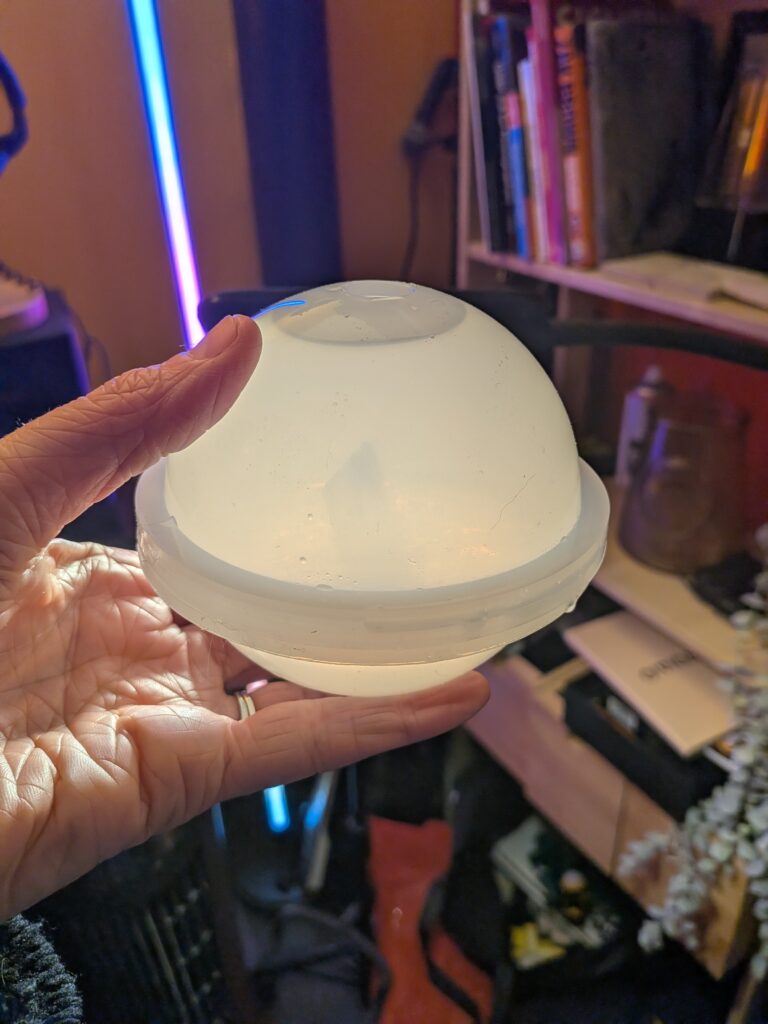
So now I wait. The sphere is sitting on my desk, it hasn’t fallen off again yet, and when I hold up to the light it looks like one of those jelly eggs with a tiny dinosaur inside you’d get as a kid. The bottom feels disconcertingly soft, so I am becoming more pessimistic about whether this cure will work as even as a prototype.
Either way I have learned a lot. There will definitely be a second iteration, whether it is strictly necessary or not!
See the progress of the bubble and other conceptual works HERE